
 PL
 EN
Yes, stainless steel can be powder coated, but it takes more work than coating ordinary steel. Smooth sheet gives the powder a poor key, and particles of carbon steel embedded in the surface during fabrication later become starting points for corrosion. That is why, when powder coating stainless steel, the durability of the coating depends above all on surface preparation. Below we explain when coating stainless steel makes sense, how to prepare the surface and how to check adhesion before you coat the whole batch.
When does powder coating stainless steel make sense?
Stainless steel protects itself: its surface is covered by a thin passive film that needs oxygen to renew itself. A well-applied, intact coating does not weaken this protection. With proper surface preparation, it gives a durable colour and extra protection against corrosion. The risk arises where the coating is damaged or has disbonded: there is little oxygen in the crevice beneath it, and with thin coatings, corrosion can creep underneath from sharp cut edges. That is why, with stainless steel, so much depends on surface preparation, and why any coating damage must be repaired.
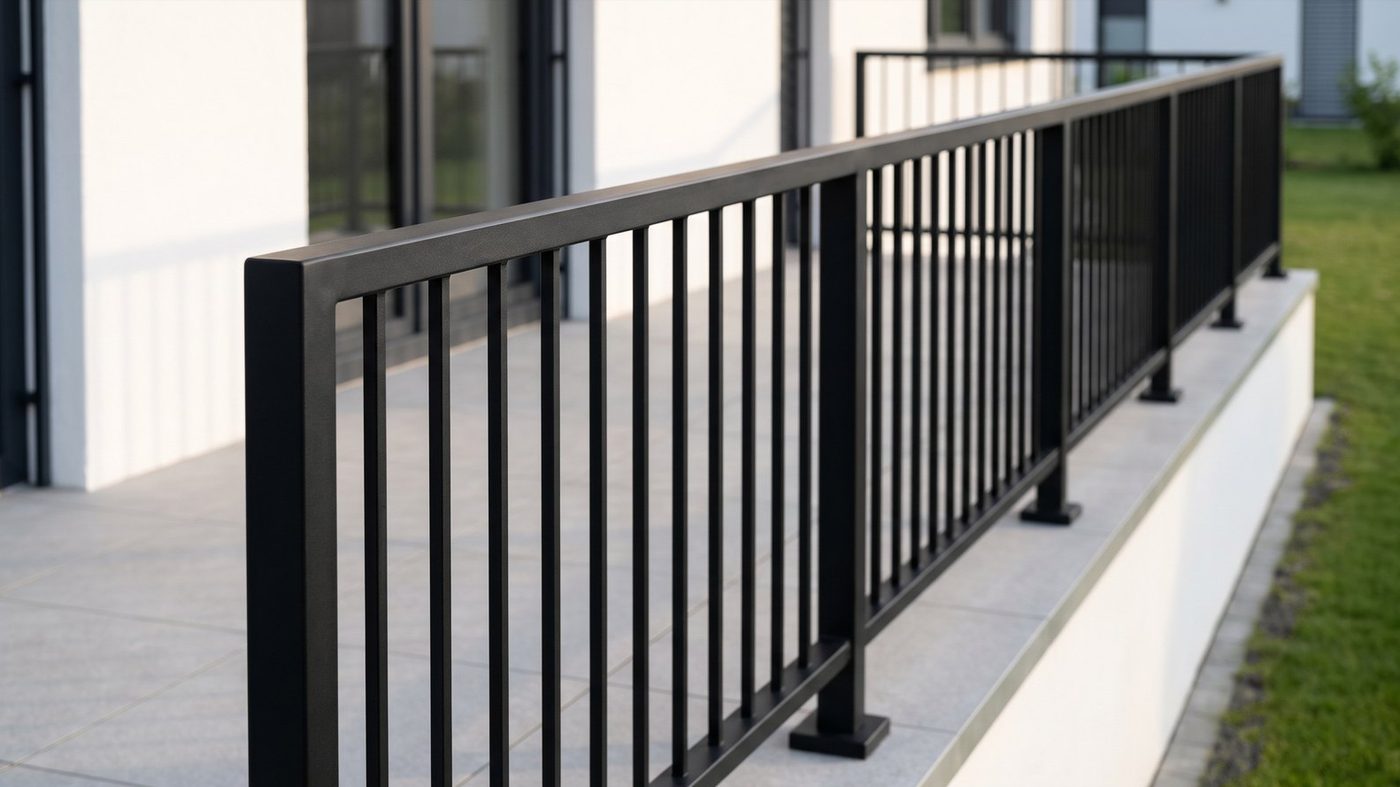
Stainless steel is most often coated to give it a colour from the RAL colour palette, for example balustrades to match the facade. The second typical case is a mixed-metal fabrication: stainless steel welded to carbon steel, which has to be protected by a coating anyway. In that case, the coating is carried over the weld and about 25 mm onto the stainless steel. This matters especially in wet areas, where stainless steel can accelerate corrosion of the adjacent carbon steel. The steel producer Outokumpu goes further and recommends coating the nobler metal in such a joint, in this case the stainless steel. If the natural look of the steel suits the project, there is no need to coat it.
How do you prepare stainless steel for powder coating?
Preparation has two aims: to give the powder a rough surface and to leave no iron on it. First, weld heat tint is removed with pickling paste or by immersion pickling. We cover the general principles in our article on surface preparation for powder coating. For another substrate that needs similar care in preparation, see Can galvanised steel be powder coated?
Abrasive blasting with clean media
Cold-rolled sheet with a 2B finish is often too smooth for the powder to adhere well. The surface is roughened by abrasive blasting, for example with glass beads or aluminium oxide. The media must be clean, free from metallic iron and chlorides, and must not have been used on carbon steel before. Carbon steel shot, or media from a blast room used for carbon steel work, leaves iron particles embedded in the surface. For the same reason, grinding and brushing are done with tools dedicated to stainless steel, never with steel wool.
Degreasing and passivation
After blasting, the part is degreased in an alkaline bath. The next step, passivation in nitric or citric acid, removes any remaining iron that could start corrosion. A ferroxyl test shows whether iron is left on the surface: a solution of potassium ferricyanide and nitric acid turns blue at contaminated spots within about 15 seconds. The solution must be washed off immediately after the test. Once passivated and dried, the part should be coated as soon as possible, because a chemically treated surface deteriorates if left standing. Where abrasive blasting is not an option, adhesion can be improved with a silane applied to thoroughly cleaned steel.
Which powder coating should you use on stainless steel?
Stainless steel does not need a dedicated powder range, because adhesion depends on surface preparation. For exterior parts such as balustrades or screens, choose a polyester powder, because an epoxy-polyester powder chalks when exposed to UV. We explain the difference in more detail in Polyester vs epoxy-polyester powder coating: what is the difference?
On a well-prepared, passivated surface, a good-quality powder coating does not need a primer.
A primer for stainless steel must not contain zinc
If a primer is needed, it must not contain zinc: a zinc-rich primer reacts galvanically with the stainless steel and degrades the coating.
Our polyester powders cure for 10 minutes at 180°C. This is time at part metal temperature, so the heat-up time has to be added to the cycle.
How do you check coating adhesion on stainless steel?
Before coating the whole batch, prepare a few test pieces and take them through the full process: degreasing, surface preparation, passivation if used, powder application and curing. Then check the quality of the coating:
- Adhesion: carry out a cross-cut test to ISO 2409. Check that the coating does not lift from the substrate and that the result meets the requirements set for the application.
- Humidity resistance: for parts exposed to water, you can run a humidity resistance test and assess adhesion again once the test is complete.
- Corrosion resistance: for parts used in harsh conditions, it is worth carrying out a salt spray test to ASTM B117. The exposure time and the acceptable degree of coating damage should be set by the requirements of the specific application.
We describe more test methods in How to assess powder coating quality?
If you would like to test a polyester powder on stainless steel, get in touch. We will send you technical data sheets and samples of TOPO powder coatings so you can check their adhesion and performance on your own coating line.


