
 PL
 EN
A wheel works in harsher conditions than most parts that go through a coating facility. It picks up road salt and brake dust, takes stone chips and is hit with harsh wheel cleaners at every wash. When powder coating wheels, the durability of the finish depends on the choice of powder, but just as much on preparing the casting, masking the mounting surfaces and getting the cure temperature right. On alloy wheels, the cure temperature also affects the strength of the alloy itself. Below we explain which coating system works on alloy and steel wheels and which parameters to set on your line.
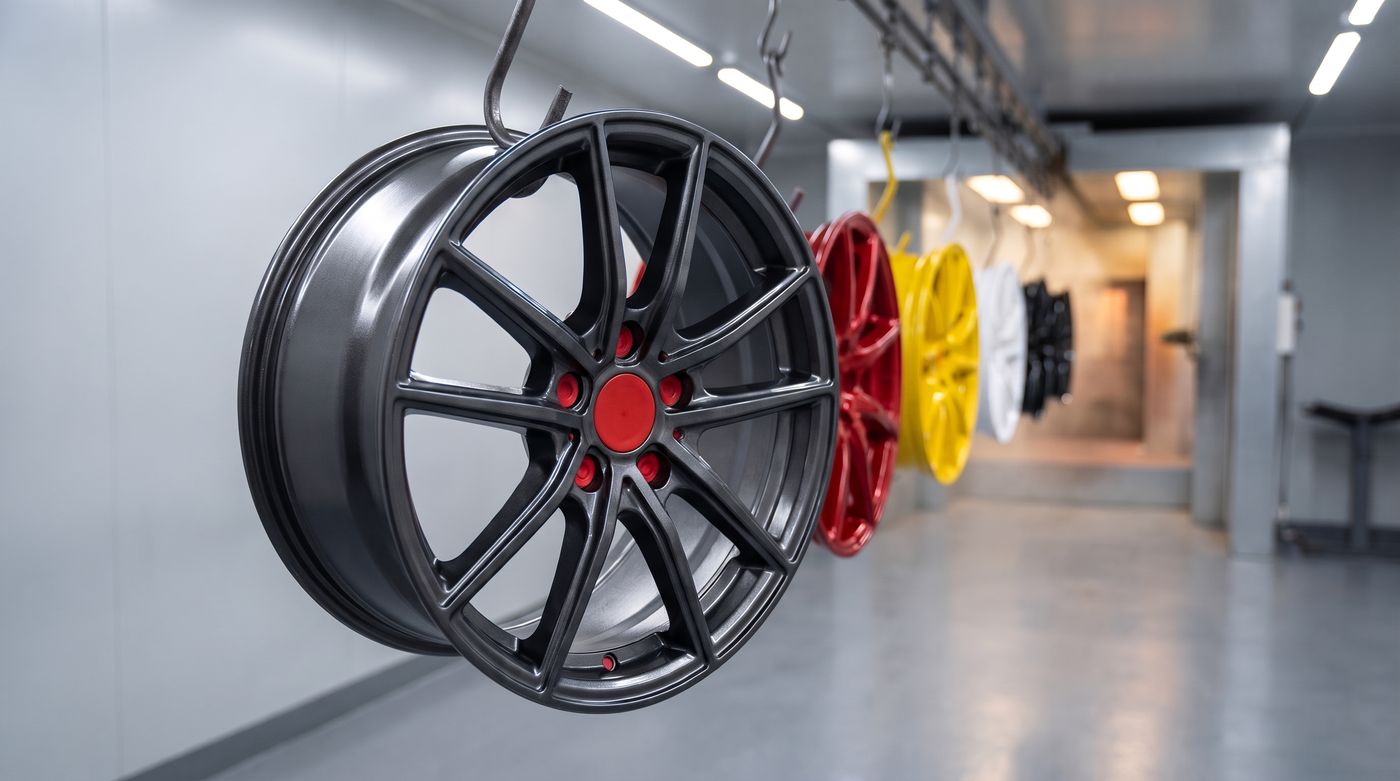
Which powder coating should you use on wheels?
For the wheel topcoat, choose an exterior-grade polyester powder coating. An epoxy-polyester powder coating is not suitable for wheels: the epoxy resin chalks under UV light, so the finish soon loses its gloss and colour.
We explain the difference in more detail in Polyester vs epoxy-polyester powder coating: what is the difference?
In the factory, wheels go through multi-stage washing and chemical pre-treatment before coating. A refinisher that only abrasive-blasts the wheels usually has no such pre-treatment. Rodger Talbert, a consultant writing for Products Finishing magazine, recommends making up for this with a coating system: a primer, a topcoat and, for metallic colours, a clear coat. The table below sets out this system for the two types of wheel. The thicknesses are Talbert's recommendations for alloy wheels coated over a primer, converted to microns, which is why the topcoat is thinner here than in a single-coat system (the data sheet for our polyester gives 90-120 µm for a single coat). For steel wheels, and whenever you use a specific powder, follow that powder's technical data sheet.
| Coat | Alloy wheel | Steel wheel | Approximate thickness |
|---|---|---|---|
| Primer | epoxy powder, gelled before the topcoat | zinc-rich epoxy powder | approx. 40-45 µm |
| Topcoat | polyester | polyester | approx. 50-75 µm |
| Clear coat | for metallics and diamond-cut wheels | for metallics | as per the data sheet |
On steel wheels, a zinc-rich primer makes particular sense. A stone chip that goes right through to the steel exposes the substrate, and from that point corrosion can creep under the coating. The zinc in the primer then slows corrosion creeping under the coating from the damaged spot and gives some local protection at the edges of the chip. Our range includes a zinc-rich anti-corrosion powder primer that cures at 180°C for 10 minutes.
We explain how to choose a topcoat for it in Anti-corrosion primer for powder coating: when do you need it and how do you use it?
Clear coat on metallics and diamond-cut wheels
A clear coat protects a metallic finish from abrasion and UV exposure. On diamond-cut wheels, it protects the bare aluminium faces where the coating was machined away. When choosing a clear powder, especially a tinted one, check its UV resistance and that it is suitable for exterior use. The technical data sheet for our polyester warns that the pigments used in transparent powders may be less UV-resistant than those in opaque powders.
How do you prepare a wheel for powder coating?
On wheels, three steps before the spray booth need more attention than on ordinary steel or aluminium parts. We cover the general principles in our article on surface preparation for powder coating.
Removing the old coating
The old coating, contamination and oxide layer are removed by abrasive blasting. Talbert recommends a medium-grit aluminium oxide or garnet rather than steel media, and a surface profile of around 38 µm. Coat the wheel as soon as possible after blasting, before a new oxide layer forms on the aluminium.
Degassing the casting in the oven
Most alloy wheels are castings. Air stays trapped in the pores of the metal, and in used wheels there are also traces of oil and fluids. During curing, these gases escape through the molten powder and leave blisters, pinholes and craters in the coating. That is why it pays to pre-bake the casting in the oven before coating. The gases should come out before spraying, so the pre-bake temperature should be at least as high as the cure temperature, but no higher than degassing requires. Apply the powder only once the wheel has cooled down: the technical data sheet for our polyester recommends spraying onto a cold substrate.
Masking the mounting surfaces
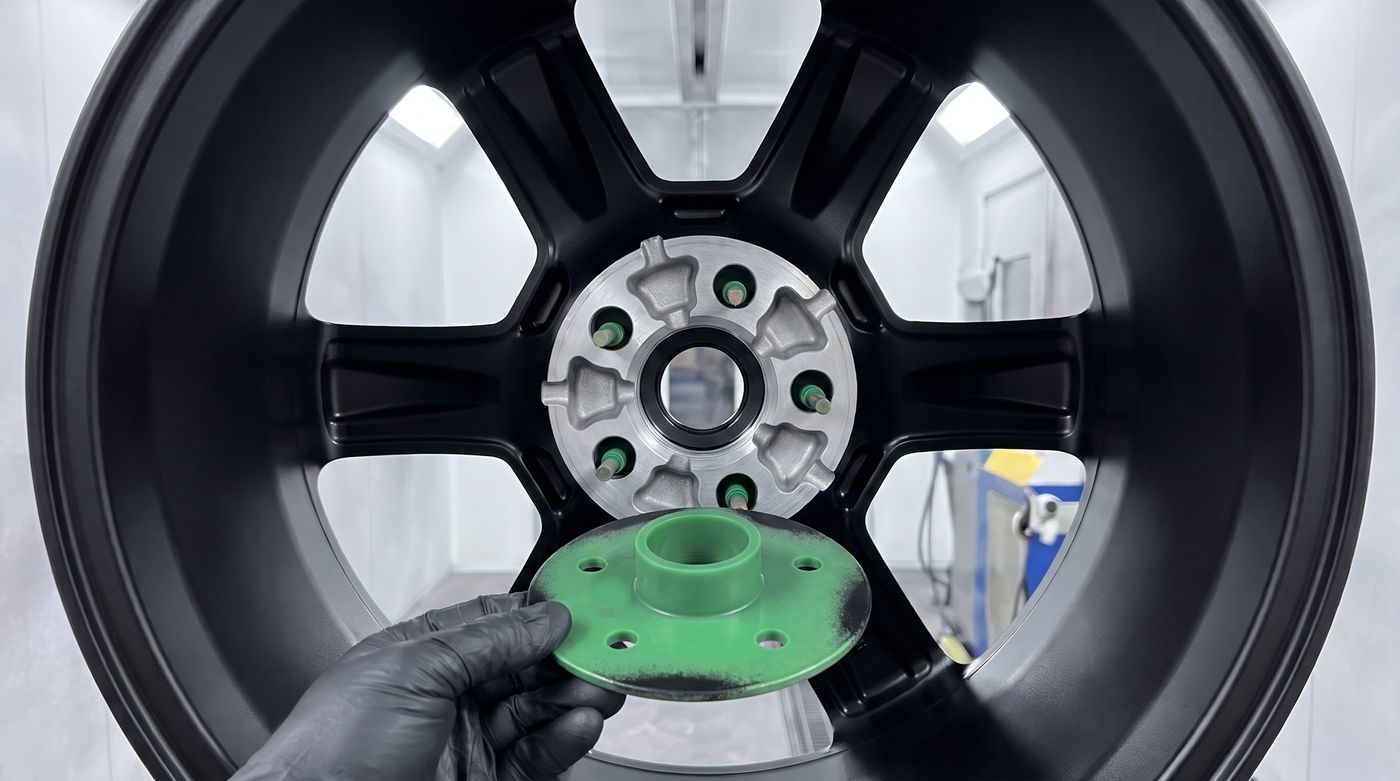
Before spraying, mask the centre bore, the hub mounting face (the flat face that sits against the hub) and the bolt or nut seats. Coating in these areas can stop the wheel seating correctly on the hub.
Coating on clamping surfaces compromises wheel security
A coating on the clamping surfaces can creep and compress under load over time, reducing the clamp load (preload) in the bolted joint. In extreme cases, this increases the risk of the wheel coming loose.
What cure temperature should you use when powder coating wheels?
Cure time starts when the wheel itself, not the oven air, reaches the temperature given in the technical data sheet. A thick-walled casting heats up more slowly than sheet metal, so measure the temperature with a data logger probe on the thickest section of the wheel, usually near the hub. Our polyester powders cure at 180°C for 10 minutes. We cover cure profiles in more detail in The role of the oven in the powder coating process.
On alloy wheels, you also need to consider how temperature affects the strength of the material. Many wheels are made from heat-treated alloys, and too high a temperature or too long in the oven can change their mechanical properties.
This is borne out by a 2009 study from Loyola Marymount University. The researchers looked at the effect of curing at 121°C and 204°C on three aluminium alloys: 2024-T3, 6061-T6 and 7075-T6. They found that the higher temperature had a negative effect on the mechanical properties of the alloys tested. These results cannot be applied directly to all wheels, however, because the study did not cover the casting alloys typically used to make them.
When setting the cure parameters, pay attention to a few points:
- Part metal temperature: follow the cure schedule on the powder's data sheet and avoid overheating the wheel unnecessarily during degassing.
- Number of oven cycles: allow for every heat cycle, including degassing, gelling the primer and curing each subsequent coat.
- Manufacturer's limits: before refinishing, check whether the wheel manufacturer allows oven treatment and what temperatures its repair procedure specifies.
If the permitted temperature is below the standard 180°C, a low-cure powder is worth considering. Our range includes powders that cure at 130°C, 140°C and 160°C.
What should you check before powder coating a batch of wheels?
Test a new coating system on a single wheel first, taking it through every oven cycle. Carry out a cross-cut adhesion test (ISO 2409) on a flat area of the wheel that will not be visible, and after curing, offer the wheel up to a hub: the centre bore and bolt seats must be free of coating. We describe other assessment methods in How to assess powder coating quality?
If you would like to test polyester, a zinc-rich primer or a low-cure powder on your line, get in touch. We will send you technical data sheets and samples of TOPO powder coatings to test on wheels.


